
Monday, September 26, 2016

The Head or the Heart
 | |
| Pacific Northwest Ballet dancers in Benjamin Millepied's "Appassionata" photo by Angela Sterling |
Normally, I think it’s important
to approach the world through a logical framework. Say, for example, when you
cast your vote for President. This year’s campaign has been overflowing with
emotion, rather than clear-eyed analysis. We’d probably be better off if every
voter applied logic to their decisions.
But let’s put politics on the
back burner for the moment.
I try to check my logical brain at
the door when I approach art. Sure, I can analyze composition, materials and
themes. I can appreciate historical or cultural references (usually). But, to
lay my bias out there, my favorite artistic encounters are those that touch my
heart.
I want to look, but I need to see and to feel.
I’ve been mulling over this need as
I consider "Tricolore," the opening program of Pacific Northwest Ballet’s new artistic
season.
“Tricolore” offers two recent
works by Benjamin Millepied, capped by George Balanchine’s monumental “Symphony
in C.”
 | |
| Pacific Northwest Ballet company members in George Balanchine's "Symphony in C" | photo by Angela Sterling |
Now, the Balanchine is certainly majestic, with a legion of women in white tutus spinning across the stage, periodically
punctuated by their cavaliers in blue. On opening night “Symphony” was notable for the
return of principal dancers Carrie Imler, paired with excellent corps de ballet
member Steven Loch, and Rachel Foster with James Moore.
"Symphony in C" is grand indeed, but I
appreciate its beauty with my intellect, rather than my soul. Instead of losing myself in a
transcendent, shivery experience, I found myself watching how Balanchine had deployed the corps de ballet, the way his movement
embodies the music.
 |
| PNB company members in Balanchine's "Symphony in C", photo by Angela Sterling |
It's a fascinating ballet, and beautifully performed, but at its end, I was unmoved.
I’m still parsing my thoughts about the two
Millepied dances on the bill. The first, “3 Movements,” was created for PNB in 2008. It’s
set to music by Steve Reich, and the dancers perform in murky lighting in subdued gray, black and brown costumes.
I was thrilled to spy Lindsi Dec
through the gloom, back from her maternity leave. And for my (meager) money, Sarah Orza continues
to demonstrate both technique and artistry that deserve more notice. But this ballet reminds me a bit of a
good Chinese meal. It’s delicious while you’re eating, or rather watching, but
after you’re done, it doesn’t stick around long.
 |
| Sarah Ricard Orza and Lindsi Dec soar in Benjamin Millepied's "3 Movements", photo by Angela Sterling |
On the other hand, I haven’t been
able to get Millepied’s “Appassionata” (set to Beethoven’s Piano Sonata #23,
the “Appassionata,” wonderfully performed by Allen Dameron) out of my mind.
This chamber ballet for six
dancers is about relationships, about motion and music, about laying your soul
bare so someone can scoop it up in the palm of their hand.
In the first half of this piece,
the dancers take the stage in brightly colored costumes. They appear with partners in
matching colors, but this isn’t a dance of monogamy. Instead, the dancers twine
around one another, fluidly exchanging partners, even performing alone.
 |
| Leah Merchant and Elle Macy in Millepied's "Appassionata", photo by Angela Sterling |
The movement seems infinite, and infinitely rigorous;
at one point I wondered if PNB's staff kept towels, water, even oxygen on hand in the
wings.
By the ballet's second half,
the dancers have swapped their brightly colored costumes for black, grey or white pajama-like outfits that seem to hint that the dancers have moved
into a more intimate relationship with one another, and with the audience.
Elizabeth Murphy and Karel Cruz
were luminescent in their long pas de deux. Murphy seemed absolutely at ease
with the elegant Cruz, as if they'd been partnered forever. I’m not sure if I’ve
seen them dance together before this performance, but look forward to seeing
them again.
 |
| PNB Principal Dancers Elizabeth Murphy and Karel Cruz in "Appassionata", photo by Angela Sterling |
I also was delighted to see Elle
Macy on opening night with William Lin-Yee, and Leah Merchant and Jerome
Tisserand are always forces of nature.
I write this post three days after the
“Tricolore” opening night, but the after-effects of “Appassionata” linger. I realize this is partly due to my excitement about the start of PNB's new artistic
season.
But I also believe “Appassionata”
stays with me because something ephemeral in that ballet touched my heart, something
beyond the technical skill of the dancers, beyond the lighting, the set and the
costumes, beyond Dameron’s interpretation of the Beethoven.
I joked to a friend that “Appassionata”
is the ballet-version of an ear worm. And I meant that in the best possible way.
I can’t stop thinking about this dance, and I can’t wait for the chance to see
it again.
Monday, September 12, 2016
Whim W'Him Inspires With New Choreography
 |
| Whim W'Him dancers, Patrick Kilbane center, in Lauren Edson's "From Under the Cork Tree" photo by Bamberg Fine Arts |
One of the things I like best
about Olivier Wevers’ contemporary dance troupe Whim W’Him is the bounty of new
choreographers it introduces to Seattle audiences.
From its formation in 2010, Whim
W’Him has presented dance makers from around the globe; artists like Anabelle
Lopez Ochoa, Penny Saunders and Ishan Rustem, as well as Wevers’ own work.
Last year, Whim W’Him introduced something
called the Choreographic Shindig; the dancers selected three choreographers
they wanted to work with, the company commissioned new dances from these
artists, and produced the performance at Seattle’s Erickson Theatre Off
Broadway.
This year, Wevers and company
reprised the Shindig, offering works by three new choreographers: Joseph
Hernandez’ “Saro,” “Swan Song,” by the New York duo Jonathan Campbell and
Austin Diaz, collectively known as MADBOOTS, and “From Under the Cork Tree,” by
Idaho-based Lauren Edson, a former dancer with Trey McIntire.
 |
| Justin Reiter and Patrick Kilbane in "From Under the Cork Tree" photo by Bamberg Fine Arts |
The audience went wild for Edson’s
work, which she says grew from her affinity for the classic children’s book about
gentle Ferdinand the Bull, who’d rather smell the flowers than fight in the
bull ring. “Cork Tree” features the amazing Patrick Kilbane as the
quasi-Ferdinand. It’s truly a joy to watch Kilbane dance; his elegant
epaulment, exquisite extensions and super human control over each muscle in his
body are simply thrilling.
I wish I had been as thrilled by
Edson’s dance as an overall composition. It starts out strong, with all seven
dancers trudging in unison like Japanese company men on their way to work. Kilbane
breaks from the pack, literally dancing against the crowd.
But Edson muddies her message
mid-stream, introducing a silly Simon Says segment. From that point, she
digresses from Ferdinand to a more light hearted, and generic, romp around the stage.
The dancers were spot on, the audience gave it a standing ovation, but I wish
Edson had been able to sustain her exploration of the iconoclast.
 |
| Tory Peil and Jim Kent in MADBOOTS' "Swan Song" photo by Bamberg Fine Arts |
From iconoclast to icon, MADBOOT'S' “Swan
Song” was far more successful at maintaining its artistic through-line. Campbell
and Diaz take the beloved balletic swan and turn her on her ear.
Beautiful Tory
Peil stands center stage, arms extended and crossed over at the wrists, a pose
familiar to anyone who’s seen “Swan Lake.” Then, instead of the fluid
fluttering arms of that19th century classic, Peil jerks and twitches
to the flickering (at times painful) strobe lighting. Simple black and white
costuming and thousands of blue faux rose petals add to the mood.
Again, Kilbane was a standout in
the MADBOOTS work, along with new Whimmer Karl Watson, who drew applause for a
sustained series of jumps.
 |
| Whim W'Him dancers in "Swan Song" photo by Bamberg Fine Arts |
It’s hard to single out any of
the seven fine dancers who comprise Whim W’Him. Peil is always technically and artistically strong, as is Jim Kent. And Mia Monteabaro continues to grow, as she demonstrated in Hernandez’ piece, “Saro.”Another great addition to this
fine group is California native Liane Aung.
Finally, is it too much
to ask that choreographers throw more meaty work Justin Reiter’s way? He’s such
a presence, but he’s often over shadowed by Kilbane.
All in all, Whim W’Him’s 2016
Choreographic Shindig is a must see. The Erickson Theatre Off Broadway is an
intimate place to take in a performance, the dancers are dynamite, and it’s an
opportunity to experience ambitious new work from fresh voices in the contemporary
dance world.
Monday, July 18, 2016
The Water Calls To Alice Gosti
 |
| "Bodies of Water" begins at Seattle Waterfront Park |
Seattle’s Waterfront Park is home
to a huge ferris wheel, a scattering of bistro tables, and, on a sunny Saturday
in July, hordes of pedestrians who shamble along the noisy sidewalk. The cars
and trucks that roar overhead on the Alaskan Way Viaduct provide an
unrelenting drone, occasionally pierced every by jangly pop music
blaring from the pedicabs that troll for tourists.
It seems an unlikely setting for
Alice Gosti’s latest durational performance, “Bodies of Water.”
 |
| The Waterfront Park stage is a perfect staging area |
And yet, at 5 p.m. on July 16th,
Gosti’s troupe of white jumpsuit-clad dancers gathered on the sidewalk to begin
the marathon five-hour event.
Like her last large-scale,
site-specific work “How to be a Partisan,” "Bodies" is a calm, centered reverie.
But, “Partisan’s” setting at St. Mark’s Cathedral allowed the audience to
both take in the performance and be lulled by the essence of spirituality that pervades the
huge Episcopal church. Waterfront Park, on the other hand, presented an endlessly evolving, and sometimes distracting, backdrop
for the dancers and musicians.
Calm was not a given; we had to find it in ourselves.
That task was often a challenge.
 |
| Alice Gosti's white-clad performers gaze west across the water as bemused audience members wonder where to look |
Fifteen minutes into the
performance, a couple of weary tourists, toddler in tow, sank down onto the
concrete steps that encircled the dancers. Their curiosity turned to annoyance
when they were asked to move a stroller out of the way. But the family stayed put for
a few minutes, watching the performers deftly avoid collisions as they wove up
and down the steps, like white salmon heading upstream to spawn.
 |
| The Alaskan Way Viaduct makes a noisy backdrop for Gosti's performers |
Eventually, the dancers left the sidewalk and regrouped to the
west, on the creosote-covered boardwalk. Dedicated audience members flowed down with
them, craning our necks to watch as the performers clustered together, swaying
slowly with the tide, like a bed of sea kelp. They held fast to their space as baseball fans pushed their way around them, heading south to the stadium.
Ultimately, I made my way up to a cement overhang, where I had a better view of the performers, the audience,
and the relentless human parade that streamed through the space.
 |
| The dancers dipped their forearms in blue paint, before climbing onto a ledge above the boardwalk |
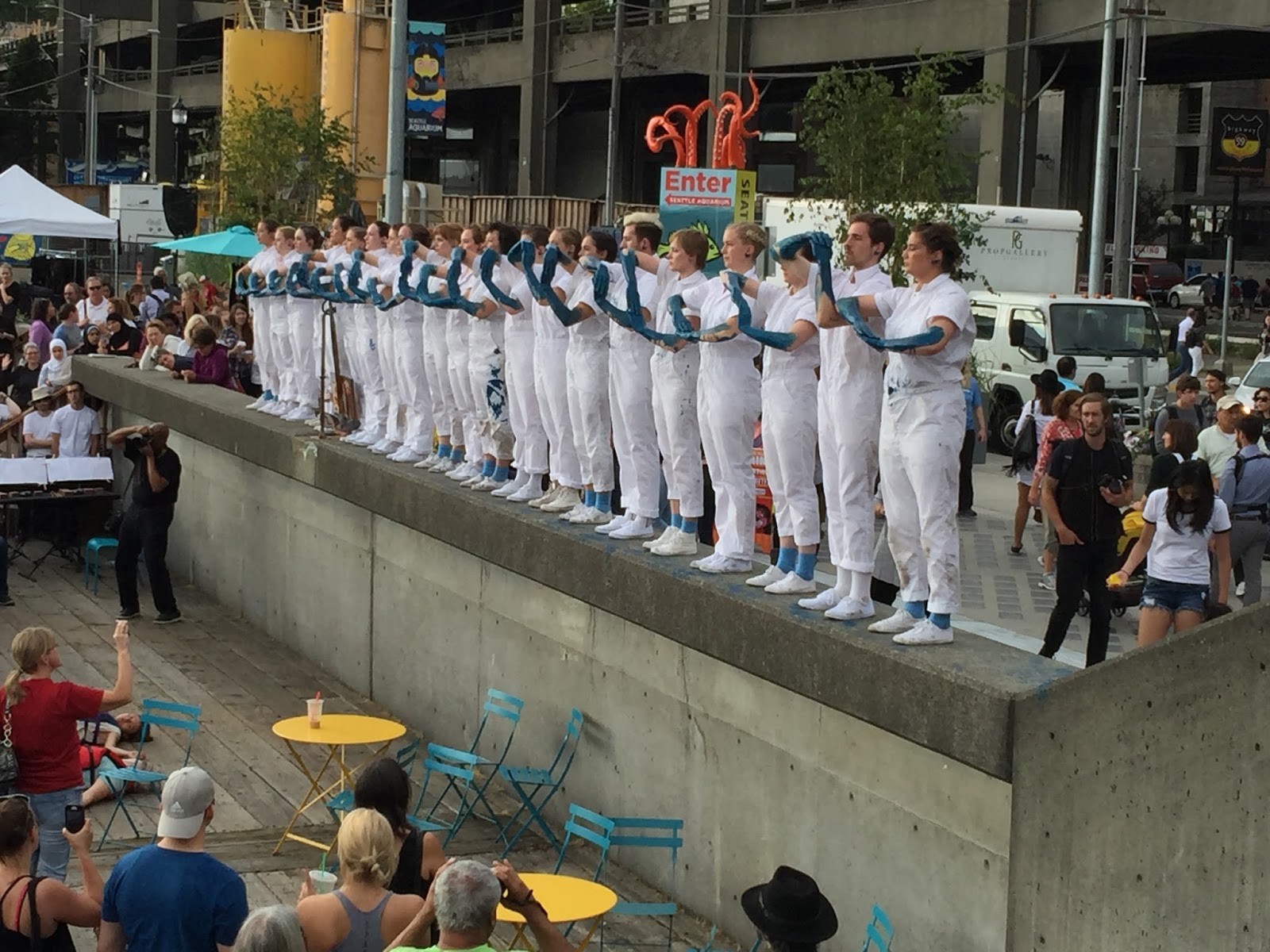 |
| They slowly undulated their arms, mimicking the movement of the water |
Looking out at Elliott Bay, I
couldn’t help but think of the similarities between that waterway and Gosti’s
performers. Despite the tanker ships, tugboats and ferries that roil the Bay on
a daily basis, the water flows on, pulled by gravity and tides, the sun, moon
and stars.
The dancers, too, followed their
own rhythms, despite the noise and commotion of a busy, urban thoroughfare. The contrast they provided to their surroundings amplified my experience of their performance, and has left me thinking about the uneasy interactions between people and our planet.
I marvel that Alice Gosti was able to realize
her vision despite, or maybe because of, the obstacles the site presented. I understand she was invited to make a work specifically for this park, a challenge if there ever was one.
Perhaps it wasn't what she would have created had she chosen the perfect venue, but for me "Bodies of Water" worked on so many levels that I went home more than satisfied by the experience.
Traces of “Bodies of Water” beckon
as I write this. Each trace is delicate and beautiful, like a shell washed up
onto the shore. And, like the bowl of beach treasures I store on my windowsill,
I’ll hold the memories of this performance close.
 |
| An enduring image from a mesmerizing performance, "Bodies of Water" by Alice Gosti |
Monday, June 6, 2016
Don't Wait To Catch PNB's 'Waiting at the Station'
 |
| Pacific Northwest Ballet Principal Dancer James Moore, surrounded by company dancers in Twyla Tharp's "Waiting at the Station" photo @Angela Sterling |
A funny thing happened on the
Bainbridge Island ferry this weekend.
It was a beautiful afternoon,
with crystal clear views of Mt. Rainier, Mt. Baker and pretty much any other
Mt. you can think of. So, I was up on the top deck, along with dozens of other
passengers, soaking it all in.
But one man was oblivious to the
scenery. Instead, he was engrossed in the program for Pacific Northwest Ballet’s American Stories, the last offering of
PNB's artistic season. Given that I’d just seen the show,
I sidled over to ask what he thought of it.
“I loved the third dance,” he
replied.
He told me he’s a ballroom
dancer, and Twyla Tharp’s ebullient Waiting
at the Station resonated with him.
 |
| PNB Principal Dancer James Moore, on bench, with company dancers in Twyla Tharp's "Waiting at the Station" photo @Angela Sterling |
Frankly, this ballet, created in 2013 for PNB, resonated with almost everybody who saw it.
One of the big reasons is principal
dancer James Moore’s knockout performance as a father who, realizing his life is
nearing its end, tries to pass on his knowledge to his son (winningly danced by
corps de ballet member Price Suddarth).
 |
| PNB Principal Dancer James Moore with corps de ballet members Elle Macy, Sarah Pasch, and Chelsea Adomaitis photo @Angela Sterling |
This story sounds grim, but it’s
actually quite exuberant. Moore and Suddarth’s relationship unfolds against the
backdrop of a lively crowd of dancers who wait at the train station. Featured
are two couples who make eyes at each other, plus a trio of long-legged Fates
(Chelsea Adomaitis, Elle Macy and Sarah Pasch, so charming). And the action is
performed to Allen Toussaint’s wonderful music, featuring pianist Allan Dameron,
Todd Larsen on bass, and drummer Gunnar Folsom with the PNB orchestra.
This ballet fires on all
cylinders: good story, great choreography, and accomplished dancing. But James
Moore is the real jewel at the heart of Waiting
at the Station.
Tharp created this dance with him
three years ago. It doesn’t just suit him, it seems to be part of Moore’s very
being. Whether he’s spinning like a top, executing a little soft-shoe shuffle,
or trying to escape the Fates that surround him, Moore makes each move seem
effortless, as if they come from his soul rather than the choreographer.
It’s thrilling to see a
performance like this; while the entire cast was technically polished, and the
dance itself is fun to watch, on opening night, Moore was transcendent. Through movement alone, he conveyed the story of a man filled with a
zest for life, and a drive to pass on that passion to his son.
 |
| PNB Principal Dancer James Moore, left, with corps de ballet member Price Suddarth photo @Angela Sterling |
Waiting at the Station brought down the house, but the other two
dances on the evening's bill were equally rewarding. Jerome Robbins’ 1944 work, Fancy Free, about three sailors on shore
leave, is always fun. On opening night Moore danced it with fellow principals
Seth Orza and Jonathan Porretta, plus Lesley Rausch and Noelani Pantastico as the two women that incite the sailors to fisticuffs.
 |
| PNB Principal Dancers Seth Orza, left, James Moore, center and Jonathan Porretta in Jerome Robbins' "Fancy Free" photo@Angela Sterling |
Sandwiched between these two
stories was George Balanchine’s lovely, lyrical Square Dance.
When I asked my ferry boat
acquaintance what he thought of those two works, he hesitated.
“They show the range of what
ballet can be,” he finally responded.
He's absolutely right. PNB’s American Stories is a season-ending gift
to dance fans. Three dances by three American masters. And a performance from
James Moore that you won’t forget.
Monday, March 21, 2016
Mortal Jumps Big And Small
 |
| Pacific Northwest Ballet company member Price Suddarth in "Little mortal jump" photo by Angela Sterling |
A friend of mine died this
weekend.
He was an artist and a scholar, a
curator and a sensitive soul.
I’m telling you this because I
couldn’t help but think of him as I watched two beautiful performances this
weekend.
“Betroffenheit,” a collaboration
by choreographer Crystal Pite and her company Kidd Pivot, and theater artist
Jonathan Young, artistic director of Vancouver’s Electric Company Theatre, explores
Young’s own descent into depression and addiction after a tragic accident, and
his difficult climb out of that abyss.
 |
| "Betroffenheit" by Crystal Pite and Jonathan Young |
The performance is daring and
emotional, at times funny, often shockingly raw. Ultimately, it is a profoundly
moving story about one man’s battle back to the world of the living.
The Kidd Pivot dancers astound
with their seemingly boneless bodies. They twist, jerk and spin as if pulled by
an invisible puppeteer. And Young, well, what can I say? He is tender, powerful
and powerless, all at the same time.
My friend, Jake, would have been
engrossed by "Betroffenheit"; its searing narrative, the dark humor, its attention
to each visual detail, the intricate sound design, and Pite’s captivating
choreography. I wish he could have seen it.
“Betroffenheit” was presented in
Seattle by On the Boards and Seattle Theater Group, and if you missed it, you’ll
have to travel south to Portland. It’s worth the trip.
You still have another weekend to
catch Pacific Northwest Ballet’s annual Director’s Choice program. As PNB’s
artistic director Peter Boal wryly noted on opening night, he’s the chooser, and
what he chose were three contemporary works.
The biggest pre-show buzz was for
New York City Ballet soloist Justin Peck’s “Year of the Rabbit.” The piece was
innovative and fresh, and exciting in its own way. But I was more moved by
Alejandro Cerrudo’s “Little mortal jump.”
 |
| PNB's Elizabeth Murphy and Dylan Wald in "Little mortal jump" photo by Angela Sterling |
The ballet begins with a literal
jump: company member Price Suddarth runs through the audience, climbs up onto
the stage, then plunges into the orchestra pit. His leap is echoed upstage by
James Moore, who descends into a dreamily dark and humorous world, accompanied by a
musical mix that runs the gamut from Philip Glass to Tom Waits.
“Little mortal jump” unfolds in a
series of duets, from Moore and Leah Merchant’s comically sultry intertwining,
to Suddarth and Chelsea Adomaitis releasing themselves from their costumes
which are velcroed to large black cubes, to Jerome Tisserand and Elle Macy, lovely as always, to
the tenderly thrilling duo of Dylan Wald and Elizabeth Murphy.
Cerrudo’s “Little mortal
jump” is about all the small joys of being alive; about laughter, and risk,
and love. To me, he seems to be saying ‘You are born into this world, but to
live fully, you need to take that jump, to seize the chances that come your
way, to spin and whirl with the energy of your fellow human beings.’
My friend Jake seized his life by
the lapels and lived it well. Alejandro Cerrudo’s dance reminded me to do the
same thing.
See Pacific Northwest Ballet’s “Director’s
Choice” at McCaw Hall March 24-27.
 |
| Jake Seniuk, died 3/18/2016 photo by Alan Lande |
Monday, February 8, 2016
It's Time For Romance
 |
| PNB's Noelani Pantastic and James Moore in Jean Christophe Maillot's "Romeo et Juliette" photo by Angela Sterling |
Ballet is built on a foundation
of romantic stories; the art form is a natural conduit for tales of love and
loss.
But there are few pas de deux
more achingly, movingly romantic than Jean Christophe Maillot’s balcony scene
from his 1996 “Romeo et Juliette.”
You know Shakespeare’s story:
Romeo and Juliette are from two rival families; they meet at a dance; sparks
fly. Romeo tracks his paramour to her house, where they swear their love to one
another.
Maillot’s version of this classic
tale, onstage now at Pacific Northwest Ballet, re-creates this scene as a
dizzying, joyful and very steamy encounter.
Romeo (PNB principal James Moore
on opening night) spies Juliette (principal Noelani Pantastico) atop her
balcony—a long, white ramp in this production. He is oblivious as his white jacket drops from his hands to the
ground. Leaping across the stage as if he
can’t contain himself, he spins on one foot, arms extended loosely over his head,
a dreamy smile on his face.
 |
| PNB's James Moore and Noelani Pantastico in "Romeo et Juliette" photo by Angela Sterling |
When Juliette descends to meet
him, we can see that her desire matches his. Her right hand flutters toward Romeo of its own accord, the physical manifestation of an attraction she can’t subdue.
The hand pulls her to Romeo, like the proverbial moth to a flame. Their palms meet, and trace together a waving path, up into the air, like wisps
of smoke from the flame itself.
The young lovers tease out their
courtship dance. Romeo grabs for Juliette; she neatly evades his hands, and
skitters away, only to sidle back to see why he hasn’t chased after her.
Finally, their coy flirtation ends. Juliette
lies draped, supine, over Romeo’s outstretched legs. He bends from the waist to
kiss her, his arms raised behind his back, elbows crooked like a bird’s wings.
And that kiss is enchanted: Juliette’s back arches her up from the ground, her
lips pressed to Romeo’s. Sigh…
PNB premiered Maillot’s ballet in
2008, and Noelani Pantastico danced the role of Juliette in every performance in that production.
It must have enchanted her, because she followed Maillot to dance with his
company, Les Ballets de Monte Carlo. She danced Juliette many times over her
seven years there. Now that she has returned to Seattle to finish her career with PNB, Pantastico brings her experience and her insight to the role. She embodies it.
Pantastico and her Romeo, Moore,
are all strength and passion, fully committed both to their characters and to the
choreography. That commitment shows in everything from the extension of their
fingers and toes, to the frankly steamy kisses they exchange.
 |
| PNB's Lesley Rausch and Jerome Tisserand in "Romeo et Juliette" photo by Lindsay Thomas |
They alternate in the title roles
with fellow PNB principal dancers Jerome Tisserand and Lesley Rausch. These two
bring equal commitment to their performances, but a very different quality to
Maillot’s choreography.
Where Moore is earthy and
muscular, Tisserand is slim and elegant. His Romeo is almost other-worldly in
his devotion to Rausch’s Juliette. And where Pantastico’s movements are
defined, sometimes almost angular,Rausch’s long arms and legs seem to curve
around the choreography. If Moore and Pantastico steam up McCaw Hall, Tisserand
and Rausch’s love shimmers and floats like a rainbow-tinted soap bubble.
“Romeo et Juliette” is much more
than this one pas de deux, of course. And the PNB dancers were uniformly strong
opening weekend.
 |
| PNB's Seth Orza, l, as Tybalt and Jonathan Porretta as Mercutio in "Romeo et Juliette" photo by Angela Sterling |
Three stand out: Principal Seth Orza looked sleek and menacing
as Tybalt. He oozed seduction with Lady Capulet, venom with Mercutio (welcome
back Jonathan Porretta!!!), and macho aggression around his minions.
Soloist Margaret Mullin excelled
as Juliette’s Nurse. When she twitches her finger to summon her young charge, we’re
amused by her spiky portrayal of the character, and somewhat awed by the fine
control she exhibits over this single digit.
And last, but not least, there’s corps
de ballet member Miles Pertl, dancing the pivotal role of Friar Laurence. The
Friar’s job is to set the story in motion, and to foreshadow its tragic ending.
Pertl threw himself into this task both physically and emotionally.
 |
| PNB corps de ballet member Miles Pertl as Friar Laurence, with Noelani Pantastico in "Romeo et Juliette" photo by Angela Sterling |
These three dancers will appear
in every performance of the current production. Lucky audiences.
I must also mention the beauty of
Prokofiev’s score, ably performed by the PNB orchestra. And costumes by Jerome
Kaplan, sets by Ernest Pignon-Ernest and lighting design by Dominique Drillot,
all enhance our experience in the theater.
Ultimately, though, “Romeo et
Juliette” is about the exultation of first love. Through Maillot’s choreography
and the skill of the PNB dancers, we get to remember the heady, giddy joy of
our own experiences. It’s simultaneously hauntingly beautiful, and achingly
sad.
As my companion said to me when
the curtain went down on Act I, after the balcony pas de deux, “I have no words for this!”
Indeed, words can't express what happens onstage in "Romeo et Juliette."
You just have to see it for
yourself.
Subscribe to:
Posts (Atom)